Behind the Lens: From Palm Springs Sun to a Sparkler Exit
Four photographs from one Palm Springs wedding show how exposure, focal length, composition, and flash decisions changed from bright afternoon sun to a sparkler exit.
A wedding day rarely stays within one kind of light. At Stephen and Heather’s Escena Golf Club wedding, the photographs moved from intense Palm Springs afternoon sun to backlit portraits, controlled flare, and a sparkler exit after dark. It was not golden hour; the early photographs were made in strong afternoon light.
The four photographs move from hard afternoon sun and controlled flare to backlight and a sparkler exit. I share the settings for each frame to show how the choices changed with the scene, not to suggest one formula for every wedding.
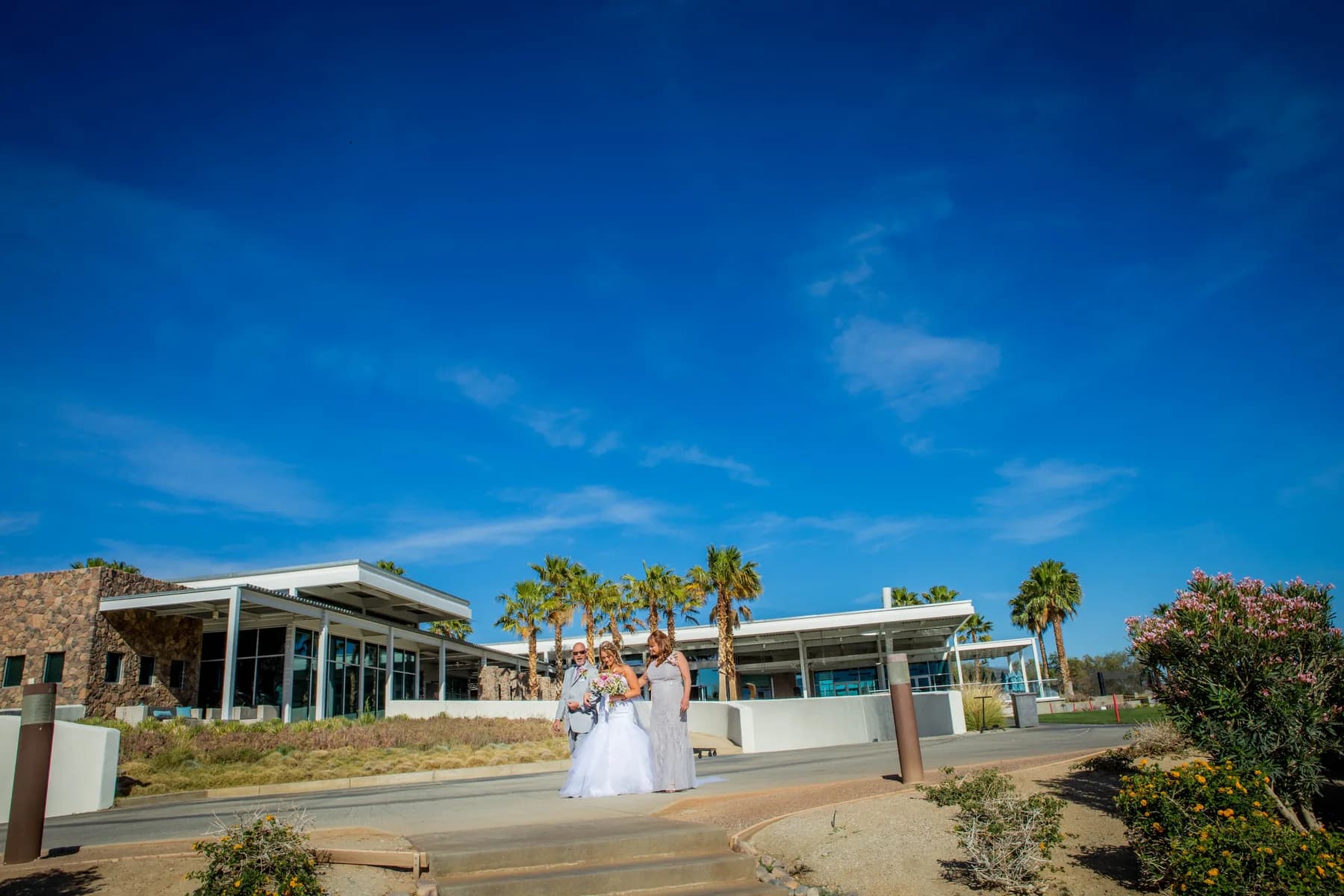
Case study 1 · Approximately 4:03 p.m.
Preserving a deep blue sky in bright afternoon light
Focal length
24mm
Aperture
f/14
Shutter speed
1/160 second
ISO
100
Flash
Fired
The photograph gives most of the frame to the saturated blue sky while keeping Stephen, Heather, two guests, the palms, and Escena’s architecture visible below it. The challenge was the large difference in brightness between the sky and the people. Exposing only for the subjects could have weakened the color and detail overhead; exposing only for the sky could have left the people too dark.
I used ISO 100 and f/14 to hold the strong afternoon light while keeping the deep blue sky. At 1/160 second, the walking group remains readable; the 24mm perspective gives the sky and Escena’s architecture room to participate in the photograph.
At 24mm, the expansive sky and architecture become part of the subject. That wide focal length is useful when scale matters, but it requires careful framing: people near the edges can stretch, vertical lines can lean, and too much empty sky can make the human moment feel insignificant.
Try this approach
Decide how much color and texture you want to retain in the sky.
Begin with a low ISO in strong daylight.
Choose an aperture that controls ambient brightness and supplies the required depth; this frame used f/14.
Keep the shutter within the usable synchronization range when flash is part of the exposure; this frame used 1/160 second.
Add only enough subject illumination to keep people readable against the brighter background.
Check skin, pale clothing, clouds, and the blue channel rather than judging exposure from the camera screen alone.
Watch edge distortion and keep important faces away from the extreme corners of a wide frame.
65mm · f/9 · 1/200 sec · ISO 100 · no flash.
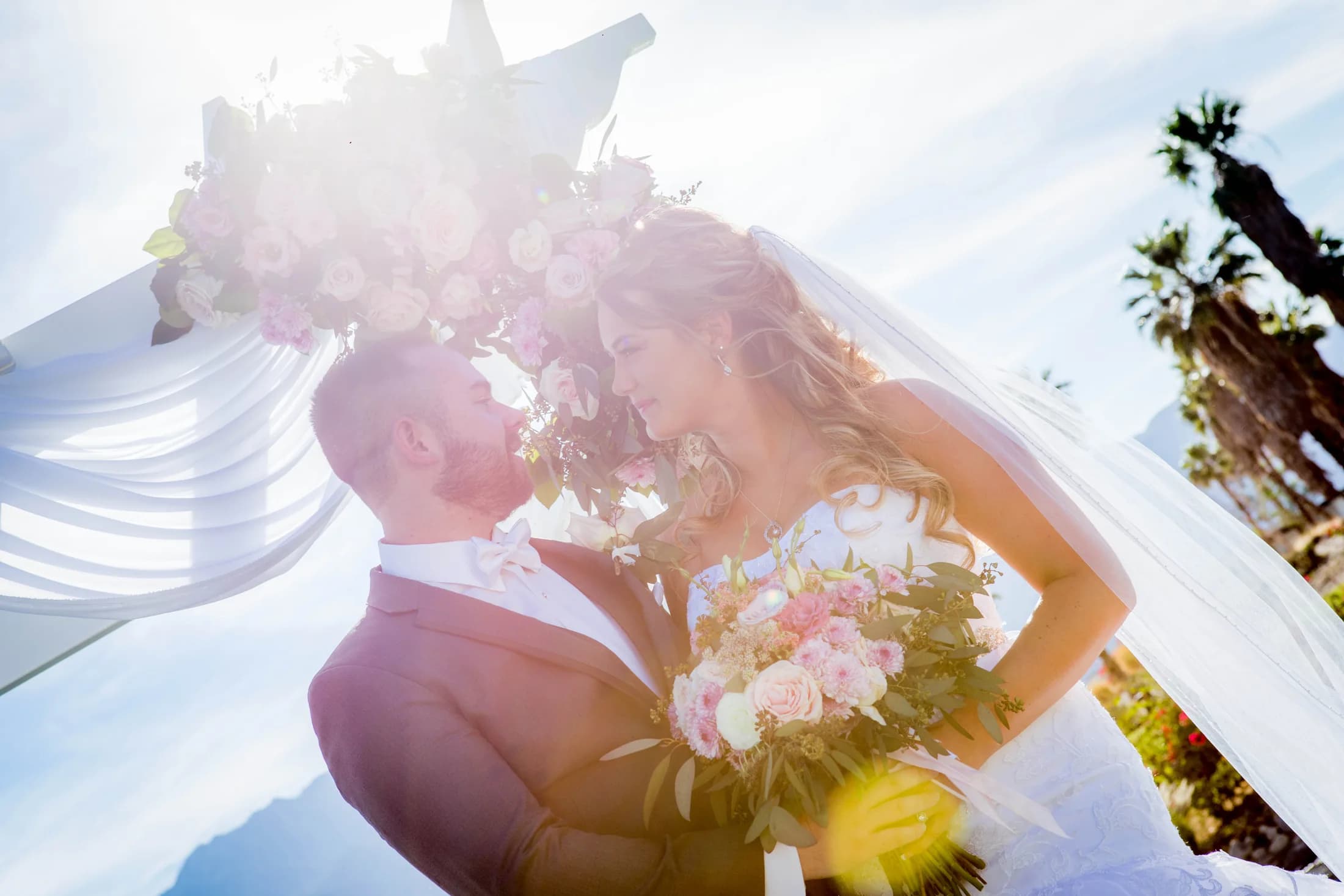
Case study 2 · Approximately 4:22 p.m.
Letting controlled flare become part of the portrait
Focal length
65mm
Aperture
f/9
Shutter speed
1/200 second
ISO
100
Flash
Did not fire
Bright desert light does not always need to be hidden until it disappears. Here, the sun enters near the upper-left portion of the composition and is partially interrupted by the ceremony flowers. Flare spreads across the frame, but Stephen and Heather’s faces, bouquet, clothing, and gesture remain readable.
At 65mm, the portrait feels intimate while preserving the flowers, veil, palms, and sky. ISO 100 and f/9 keep useful detail in the bright scene, and 1/200 second holds the pose and veil. I let the available sunlight shape this frame without flash.
The practical lesson is to move in very small increments. A few inches can change whether flare adds atmosphere or erases facial detail. Capture a cleaner variation as well so creative flare remains a deliberate option rather than the only usable frame.
52mm · f/8 · 1/160 sec · ISO 100 · flash.
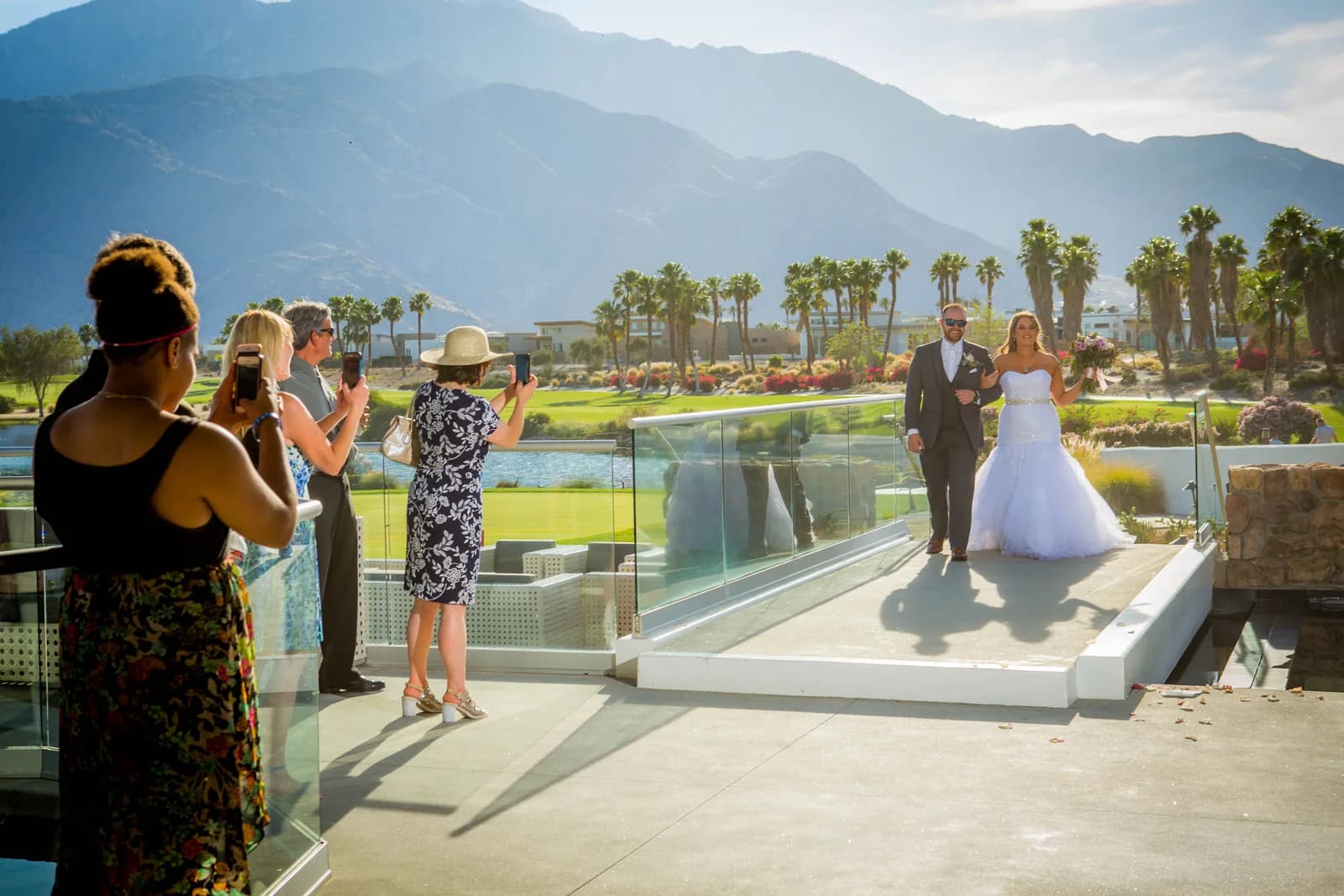
Case study 3 · Approximately 4:50 p.m.
Balancing backlit subjects with the mountain view
Focal length
52mm
Aperture
f/8
Shutter speed
1/160 second
ISO
100
Flash
Fired
Stephen and Heather are walking toward the camera while the sun remains behind them and to the right of the frame. The mountains, palms, water, and bright sky create the sense of place, but they also produce a difficult exposure: the background is strongly illuminated while the couple’s front-facing side receives less natural light.
With the sun behind Stephen and Heather, I needed to preserve the bright mountain setting while keeping the couple readable. ISO 100 and f/8 hold depth and background detail; 1/160 second suits their measured movement. The 52mm view keeps the couple prominent within the larger scene.
At 52mm, the image keeps the couple prominent without losing the guests, glass railing, water, palms, and mountain layers. The railing and walkway create natural leading lines toward the subjects.
Try this approach
Evaluate the brightest important background detail before setting the subject exposure.
Decide how much mountain and sky detail belongs in the final frame.
Use fill light when necessary to prevent a backlit subject from becoming a silhouette.
Choose a shutter speed that reflects how quickly the subjects are moving.
Leave room for people walking toward the camera and track focus continuously as a general technique.
Check reflections, railings, phones, and guests around the edges before the key moment reaches the frame.
16mm · f/2.8 · 1/50 sec · ISO 1600 · flash.
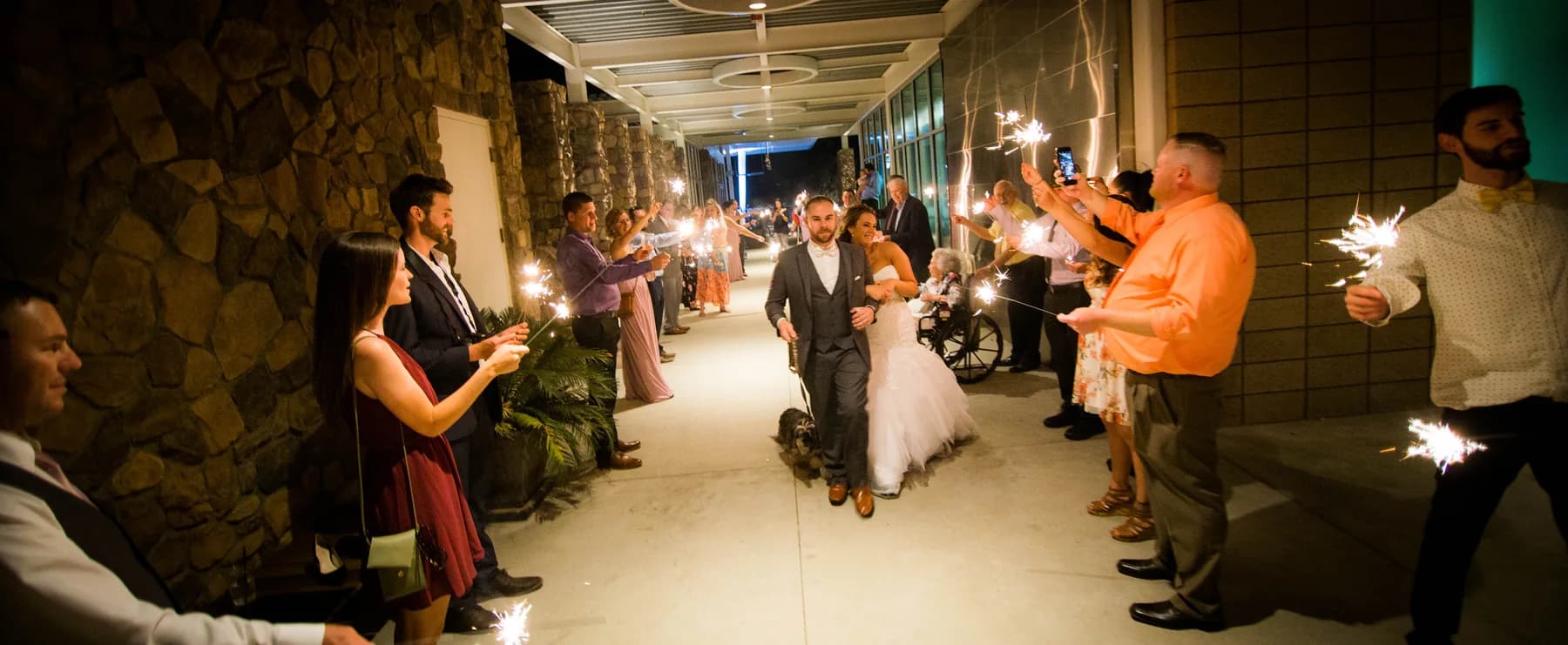
Case study 4 · Approximately 9:30 p.m.
Photographing movement during a low-light sparkler exit
Focal length
16mm
Aperture
f/2.8
Shutter speed
1/50 second
ISO
1600
Flash
Fired
A sparkler exit combines several problems at once: low ambient light, bright point highlights, people moving toward the camera, guests extending into the walkway, and very little time to repeat the action. This frame keeps the corridor, guests, sparklers, architecture, and moving couple visible within one panoramic composition.
The 16mm view gives the couple room to move within the corridor of guests and sparklers. At f/2.8 and ISO 1600, the frame retains ambient atmosphere. A 1/50-second shutter lets some sparkler movement show, so timing the couple’s position remains important.
The goal in this kind of image is not to freeze every spark into a perfect dot. Some light trails and movement communicate the energy of the exit, while the couple must remain readable enough to anchor the frame.
Try this approach
Establish a clear, safe path before the couple begins moving.
Position yourself before the action and decide how you will move or hold position.
Use a focal length wide enough to include the environment without placing important faces at heavily distorted edges.
Balance aperture, ISO, and shutter speed according to how much ambient atmosphere and motion you want.
Expect the couple’s distance to change quickly; continuous focus or a planned focus zone can help as general approaches.
Watch sparkler highlights so they do not dominate every part of the frame.
Ask for a steady walking pace when event timing permits.
Capture a short sequence because expressions, spacing, sparks, and body positions change from frame to frame.
Coordinate all sparkler activity with the venue and event team; photography never overrides safety rules.
4 scenes compared
Settings changed with the light.
Photo
Challenge
Focal length
Aperture
Shutter
ISO
Flash
Blue-sky environmental frame
Bright sky vs. people
24mm
f/14
1/160s
100
Fired
Sun-flare portrait
Direct sun in frame
65mm
f/9
1/200s
100
Did not fire
Backlit entrance
Moving subjects against bright mountains
52mm
f/8
1/160s
100
Fired
Sparkler exit
Low light and forward movement
16mm
f/2.8
1/50s
1600
Fired
Across the wedding day
Common lessons
Exposure settings must respond to the scene, not a memorized recipe.
Focal length changes how much environment participates in the story.
Flash can support subject visibility without requiring the background to disappear.
Backlight and flare are creative tools only when essential facial detail remains intentional.
A low-light image may balance sharpness with atmosphere rather than eliminating every trace of motion.
The numbers describe one frame; the creative and safety decisions still depend on the scene.
Questions about the photograph
Behind the frame.
What settings help preserve a blue sky in wedding photographs?
In the featured 24mm frame, Alexo Photography used ISO 100, f/14, 1/160 second, and flash. Those settings controlled the bright ambient exposure while keeping the people readable, but the correct exposure will change with the light and flash system.
How do you photograph a couple with the sun behind them?
First decide how much background detail to retain, then expose deliberately for that balance and add subject illumination if needed. The Escena entrance photograph used 52mm, f/8, 1/160 second, ISO 100, and flash.
What focal length works for a sparkler exit?
A wide focal length can include the couple, guests, sparklers, and architecture while allowing for unpredictable movement. This photograph used 16mm, but the best choice depends on space, distance, and the amount of edge distortion you can accept.
What settings were used for the sparkler exit?
I photographed this frame at 16mm, f/2.8, 1/50 second, and ISO 1600, with flash.
Are these settings a formula?
No. They are verified examples from one wedding. Available light, subject speed, distance, desired motion, flash limits, and equipment all affect the final exposure.
Begin the conversation
These four photographs belong to the same wedding, but each required a different balance of environment, movement, and light. See the complete celebration and the Escena Golf Club venue guide, or explore Alexo Photography’s wedding work across Southern California.