Behind the Lens: Photographing a Leoness Cellars Wedding
Four photographs reveal how composition, focal length, and exposure changed from a backlit preparation room to bright vineyard sun and movement inside the Leoness Cellars barrel room.
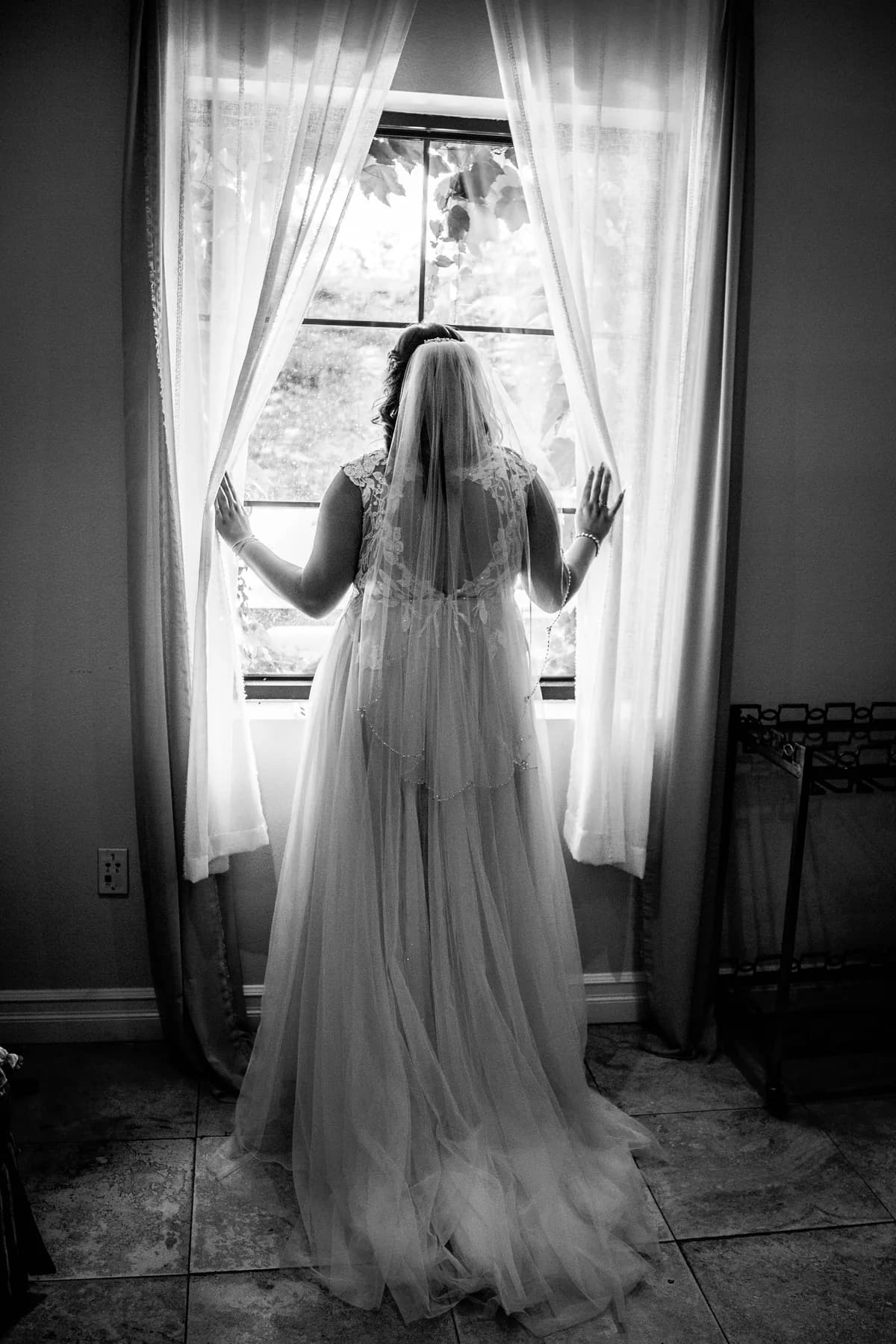
Leoness Cellars, Temecula · 35mm · f/4 · 1/160 sec · ISO 640 · no flash.
A wedding at Leoness Cellars can move through radically different kinds of light. Within a few hours, a photographer may work beside a bright preparation-room window, beneath direct afternoon sun, across layered vineyard rows, and inside a darker barrel room filled with movement.
These four photographs show how my approach changed with the light: a window portrait, a bright ceremony, layered vineyard rows, and movement inside the barrel room. The settings shown belong to these specific frames; use them as examples of decisions, not fixed recipes.
Case study 1 · Approximately 3:40 p.m.
A backlit bridal portrait at the window
Focal length
35mm
Aperture
f/4
Shutter speed
1/160 second
ISO
640
Flash
Did not fire
The exterior and sheer curtains are much brighter than the room, creating a wide tonal range. Increasing the exposure too far would further brighten the window, while exposing only for the exterior could remove important separation in the veil and gown.
The curtains create a natural frame around Deidriana, and her position gives the arms, veil, and lace a readable outline against the luminous window. The centered composition simplifies the room and turns the brightness difference into the central design of the portrait.
Preparation spaces are not always evenly lit or visually simple. Recognizing the strongest available light can transform a difficult room into a quiet portrait that feels intentional.
Try this approach
Decide whether the subject, window view, or silhouette is the visual priority.
Separate the veil and arms from the brightest background areas.
Check critical highlights while accepting that some exterior brightness may be intentional.
A black-and-white finish can emphasize shape and tonal structure, but cannot recover uncaptured detail.
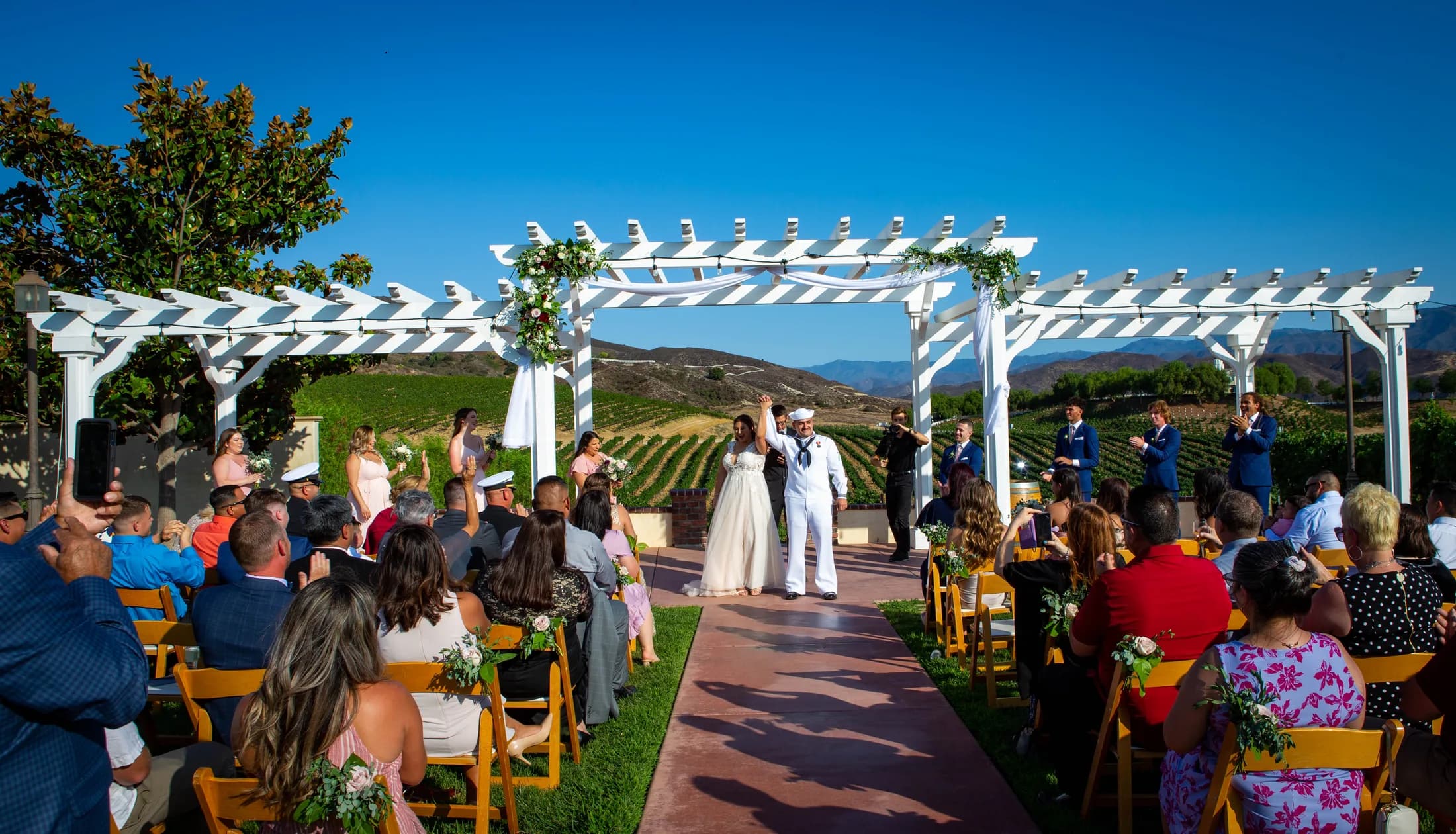
24mm · f/10 · 1/160 sec · ISO 100 · flash.
Case study 2 · Approximately 4:54 p.m.
Holding a blue sky during the ceremony
Focal length
24mm
Aperture
f/10
Shutter speed
1/160 second
ISO
100
Flash
Fired
The scene includes a vivid sky, direct sunlight, white pergolas, a white gown, Navy whites, shaded guests, and a spontaneous moving moment.
I kept Deidriana and Gustavo at the center of a 24mm frame while including the guests, pergola, vines, hills, and blue sky. ISO 100 and f/10 helped hold detail and color in the bright scene. The broad composition lets the recessional feel like a moment within the entire venue, not an isolated portrait.
A ceremony photograph should preserve more than faces. Careful exposure and a wide storytelling composition retain the setting the couple selected while still prioritizing the moment.
Try this approach
Protect important highlights in white clothing and bright architecture.
A low ISO and smaller aperture can help retain color in a bright sky.
Compose wide enough to establish the venue without making the couple disappear.
Anticipate the recessional gesture before it begins.
Test any supplemental-light plan before the ceremony.
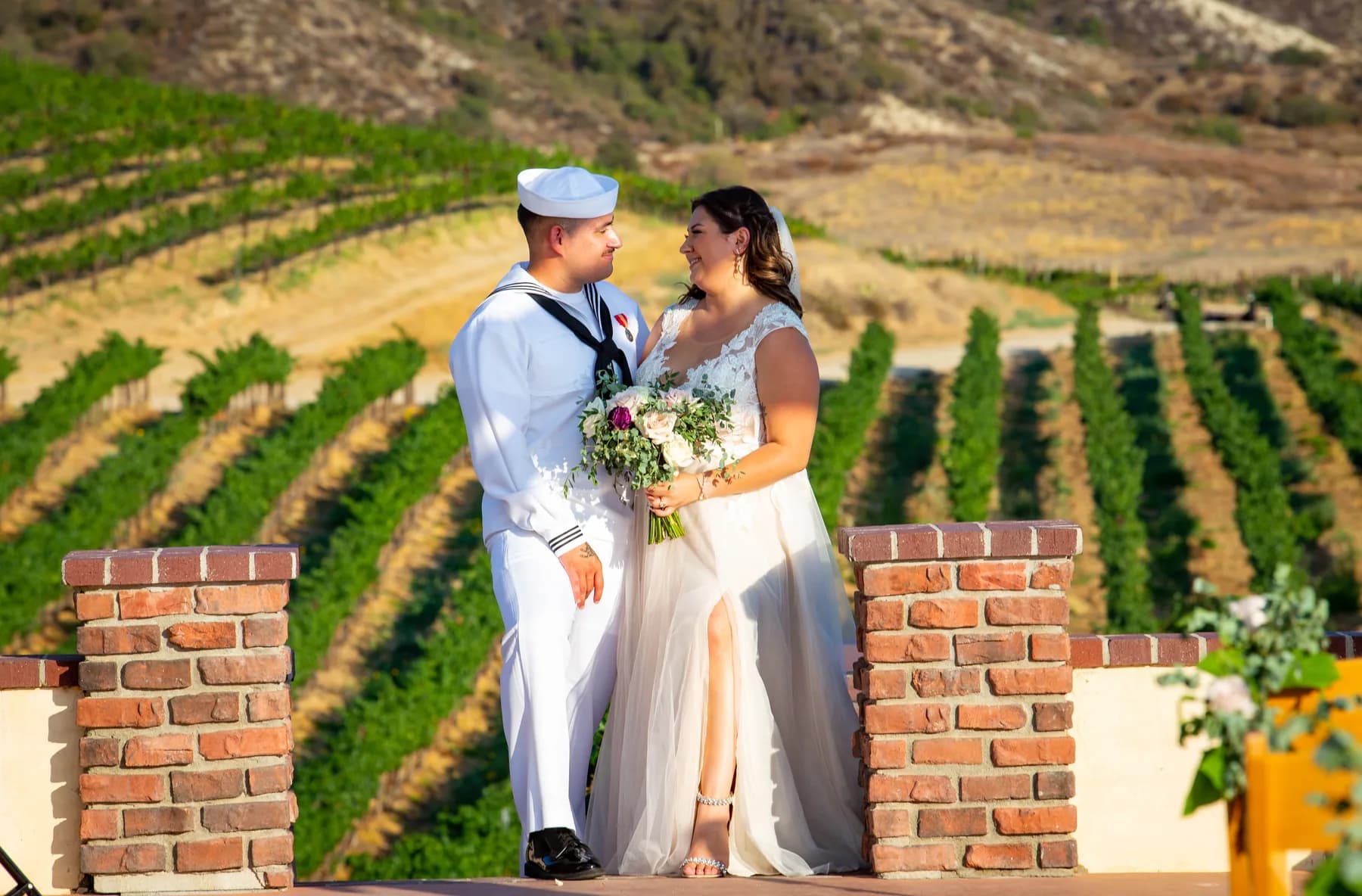
200mm · f/9 · 1/160 sec · ISO 100 · flash.
Case study 3 · Approximately 5:23 p.m.
Compressing the vineyard at 200mm
Focal length
200mm
Aperture
f/9
Shutter speed
1/160 second
ISO
100
Flash
Fired
Vineyard rows and hills introduce many competing lines. The goal is to arrange them into a clean, layered background while keeping both subjects sharp and visually prominent.
At 200mm, the distant rows appear closer together behind Deidriana and Gustavo. That perspective simplifies a busy background, while f/9 gives useful depth for two people standing on a similar focus plane. The venue stays present without competing with the couple.
A photographer does not need to remove the venue from a portrait to create visual focus. Focal-length and position choices can keep the location recognizable while directing attention back to the couple.
Try this approach
Step back and consider a longer focal length when a background feels busy.
Align the couple with the strongest repeating rows before refining the pose.
Keep both faces near the same focus plane.
Check the frame edges for bright distractions.
Evaluate facial shadows and white clothing carefully in direct light.
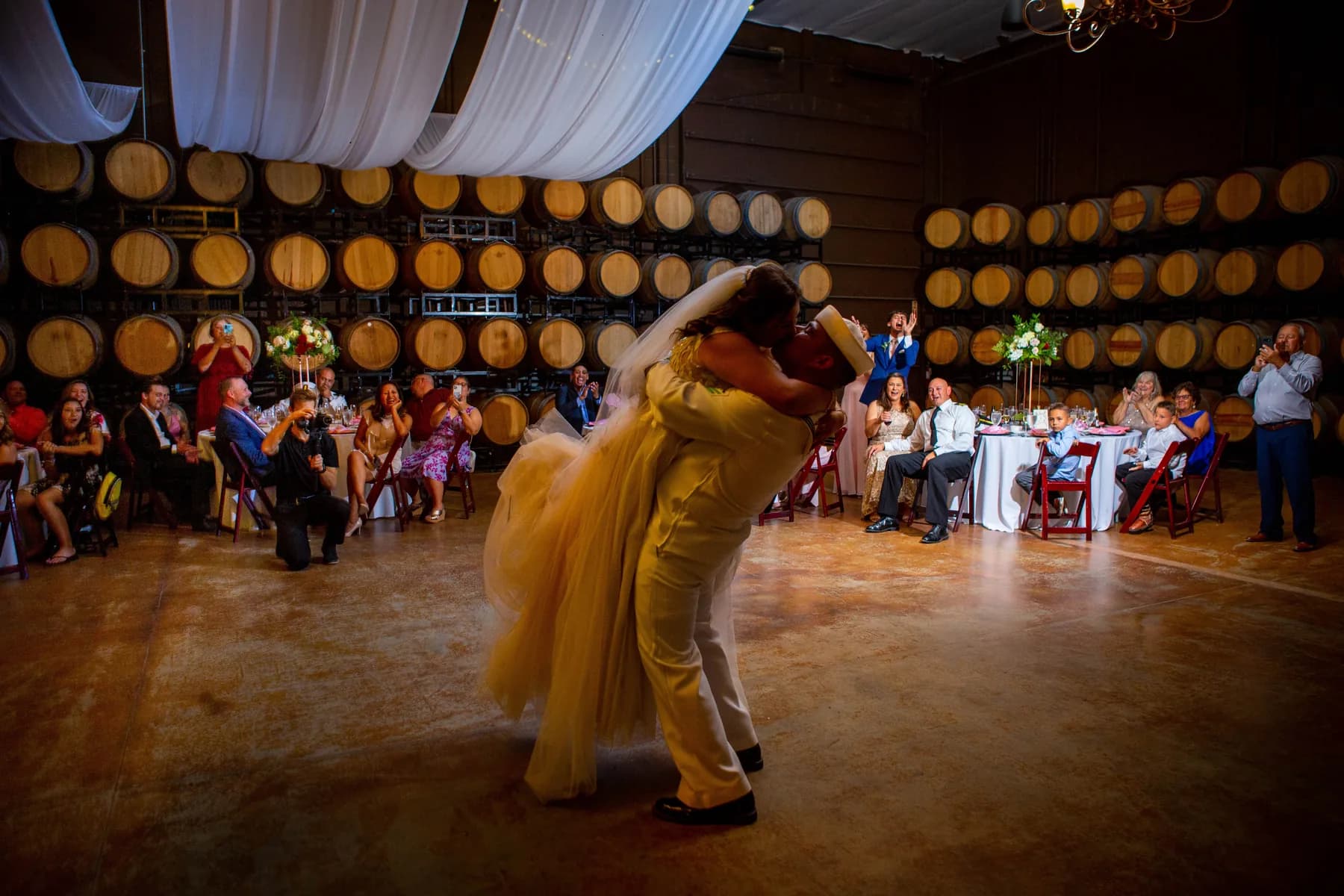
24mm · f/2.8 · 1/80 sec · ISO 1250 · flash.
Case study 4 · Approximately 6:16 p.m.
Movement inside the barrel room
Focal length
24mm
Aperture
f/2.8
Shutter speed
1/80 second
ISO
1250
Flash
Fired
The couple is moving quickly in a darker interior, but the photograph also needs to retain the wine barrels, warm atmosphere, and guests’ reactions.
The 24mm view keeps the couple inside the reception atmosphere instead of separating them from it. At f/2.8 and ISO 1250, the exposure retains some of the room’s warmth; 1/80 second makes timing especially important when people are moving.
Reception coverage should preserve both expression and atmosphere. The room should still feel like the room the couple chose, even when additional light is needed to photograph fast action.
Try this approach
Track the subject before the peak gesture.
Leave space for movement that cannot be precisely predicted.
Decide whether slight ambient motion supports the story or a faster shutter is needed.
Balance added light with the room instead of eliminating its atmosphere.
Watch guests’ reactions; they often strengthen the central moment.
4 scenes compared
Settings changed with the light.
Photo
Challenge
Focal length
Aperture
Shutter
ISO
Flash
Window portrait
Backlight
35mm
f/4
1/160s
640
Did not fire
Ceremony recessional
Bright sun and blue sky
24mm
f/10
1/160s
100
Fired
Vineyard portrait
Background compression
200mm
f/9
1/160s
100
Fired
Barrel-room movement
Low light and action
24mm
f/2.8
1/80s
1250
Fired
Across the wedding day
Common lessons
Identify the visual problem before choosing settings.
Preserve the location without letting it overpower the people.
Use focal length as a compositional decision, not only a framing convenience.
Anticipate movement before the decisive gesture.
Use the settings as a starting point; read the light and movement in front of you.
Venue familiarity helps a photographer prepare for rapid changes in light.
Questions about the photograph
Behind the frame.
Are these the exact settings used?
Yes. The focal length, aperture, shutter speed, ISO, and flash status shown are the settings for these photographs.
Can photographers copy these settings at another wedding?
They are useful references, but not fixed recipes. Light, distance, movement, flash output, and equipment can change the required exposure.
Why use 200mm for a vineyard portrait?
A longer focal length can visually compress repeating vineyard rows, simplify a busy background, and keep attention on the couple.
How do you photograph a bright sky and white wedding clothing together?
Protect important highlights, use an appropriately low ISO and aperture for the available light, and evaluate whether supplemental light is needed. The exact solution depends on the scene.
Why keep some ambient light in a reception photograph?
Ambient light preserves the character of the room. The goal is to balance atmosphere with enough sharpness and illumination for the moment.
Begin the conversation
These four frames move from quiet preparation to bright ceremony light, layered portraits, and a reception in motion. The settings changed each time, but the purpose remained the same: preserve the people, atmosphere, and character of the place in one connected wedding story. Planning a Leoness Cellars or Temecula Wine Country wedding? Explore the complete gallery and venue guide, then check availability for your date.